The Real Difference Between a Tire API and a Tire Data Feed
Tire API or tire data feed — which do you actually need? This guide explains the real difference, the use cases for each, and how to choose the right approach for your project.

If you're building something that needs tire data — a search tool, an e-commerce integration, a fitment widget, an inventory system — you'll quickly encounter two terms used almost interchangeably: tire API and tire data feed. They sound similar. They're not the same thing, and choosing the wrong one for your use case creates problems that are expensive to fix later.
This article explains what each actually is, what the practical differences are, and how to decide which approach your project needs.
What Is a Tire Data Feed?
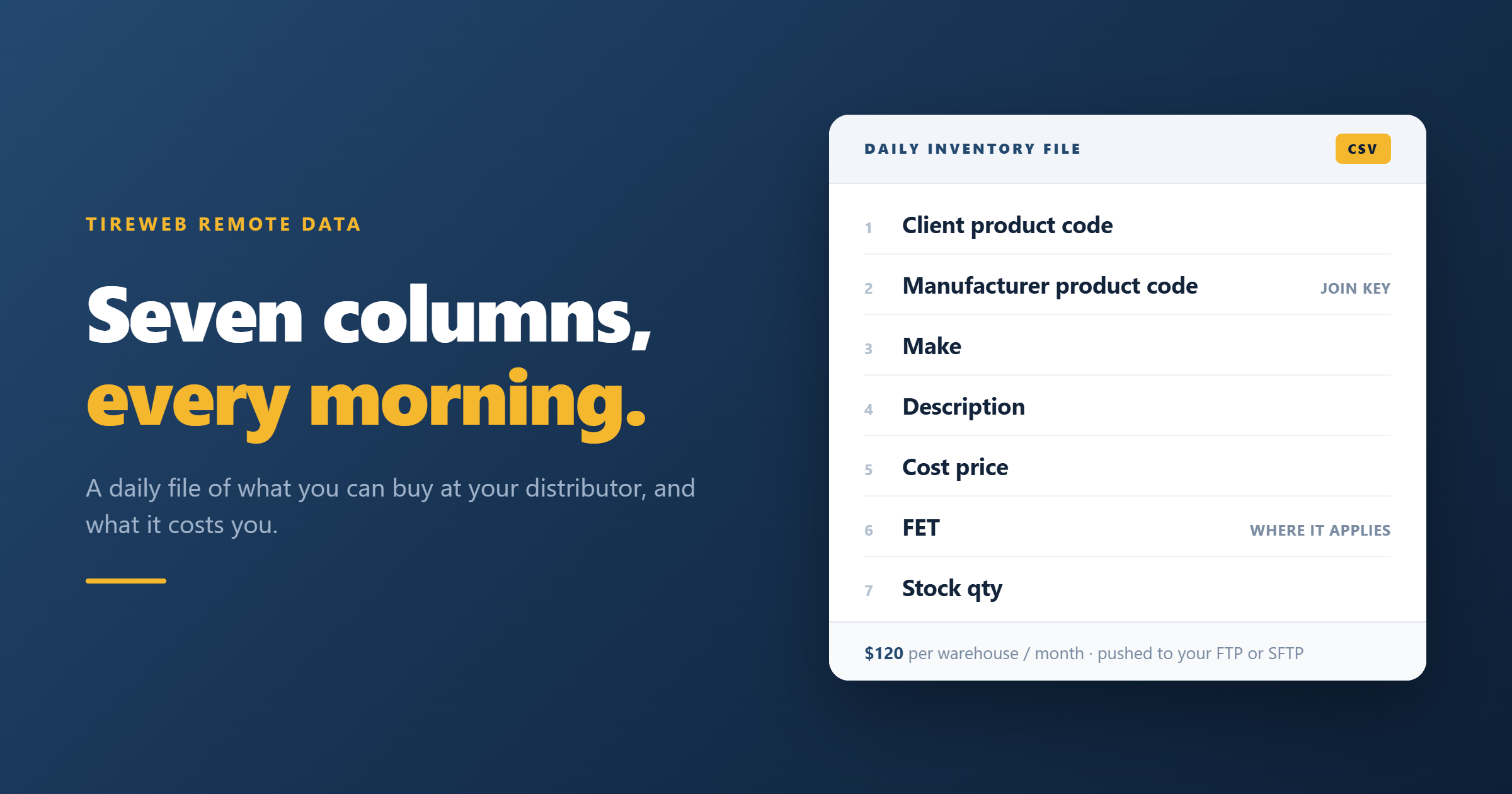
A tire data feed is a batch export of tire catalog data — typically a file (CSV, XML, JSON, or a proprietary format) delivered on a schedule. The feed might update daily, weekly, or in some cases multiple times per day. Each update replaces or supplements the previous version with current product, pricing, and availability data.
When you receive a tire data feed, you're downloading a snapshot of the data at a point in time and loading it into your own system. Your system then serves queries from its local copy of the data, not from the original source. The data is as current as the last feed update.
A tire data feed is the right choice when:
- You need to import large volumes of data into an existing system that manages its own database
- Your architecture requires local data storage for performance or reliability reasons
- You're running batch processes (like nightly catalog updates) rather than real-time lookups
- You need to apply significant data transformation before use and want to do that on your own infrastructure
What Is a Tire API?
A tire API is a real-time interface that lets your application query tire data on demand. Instead of downloading a copy of the data and managing it locally, you send a request — 'give me all available 225/65R17 all-season tires with pricing' — and the API returns a response in real time, drawn from live source data.
With an API, you're not managing a local copy of the data. The data lives in the API provider's system, stays current continuously, and your application retrieves exactly what it needs when it needs it.
A tire API is the right choice when:
- You need real-time pricing and availability — data that's accurate to the moment, not to the last batch update
- You're building a consumer-facing search or fitment tool where stale data would create a poor experience
- Your use case involves querying a subset of the catalog (by size, by vehicle, by brand) rather than ingesting everything
- You want the data provider to handle catalog maintenance and updates without any action on your part
- You're building a new application and want to avoid the infrastructure overhead of managing a large local data store
Where the Difference Actually Matters
Pricing Accuracy
Tire pricing changes frequently. Wholesale prices move with raw material costs and market conditions. Distributor pricing changes with promotional windows. If you're displaying prices to end customers or powering quote generation, stale pricing creates real problems: customers get quoted a price that's no longer accurate, or you sell at a price that no longer reflects your cost.
A data feed that updates once daily will have pricing that's correct at midnight but potentially wrong by 10am the next day. A real-time API returns current pricing every time it's called. For any application where pricing accuracy matters, this is a significant distinction.
Availability
Tire availability is even more volatile than pricing. A popular size can go from 200 units in stock to 0 in a few hours during a busy period. A data feed showing availability from last night's update is actively misleading by mid-morning of the next day.
Applications that show availability to customers — 'in stock at this location', 'available for next-day delivery' — need real-time availability data. A feed-based approach to availability will produce incorrect results with a frequency that damages customer trust.
Catalog Depth and Freshness
New tire products launch continuously. Existing products are updated, renamed, or discontinued. A data feed that's imported periodically will lag on new products and may contain discontinued SKUs that are no longer available.
A well-maintained API reflects these changes immediately as the underlying catalog is updated. You don't need to manage an import process or monitor for feed updates — your application simply gets accurate data every time it queries.
When You Might Want Both
Some architectures use both approaches for different purposes. The bulk product catalog — brands, product lines, specifications, fitment data — is imported via a data feed and stored locally for fast querying. Real-time pricing and availability are retrieved via API at the moment they're needed, overlaid on the locally stored catalog data.
This hybrid approach is common in high-traffic e-commerce applications where query performance is critical but pricing and availability accuracy cannot be compromised. The catalog data — which changes slowly — lives locally. The volatile data — pricing and availability — always comes from a live source.
Questions to Ask Your Data Provider
Whether you're evaluating a data feed, an API, or both, ask these questions before committing:
- How frequently does the data update, and what triggers an update?
- What is the latency between a price change at the source and that change being reflected in the feed or API response?
- How are new products added and discontinued products flagged?
- What happens if the API is unavailable — does your application have a fallback?
- What is the rate limit on API calls, and does it match your expected query volume?
- What data format and authentication method does the feed or API use?
The answers to these questions will tell you more about fit for your use case than any feature list.
Tireweb Connections provides both REST API access and structured data feeds for tire catalog, pricing, and availability data — built on 25 years of tire industry data infrastructure. tireweb.com/connections