AI Agents Are Already Buying Tires. Can They Buy From You?
We're seeing AI agents complete purchases on dealer websites. For tire dealers and distributors, accurate data and a working online buying process are becoming even more important.
I've been building tire software since we founded Tireweb in 2000. In that time I've watched the way people buy tires change more than once: from the phone and the counter, to search engines, to mobile. Each shift rewarded the dealers whose information was easiest to find and easiest to trust.
We're in the middle of another shift, and it isn't theoretical. Across the dealer websites we run at Tireweb, we're already seeing AI agents browsing catalogs, making inquiries and buying tires. Not a pilot, not a demo. Software acting on behalf of real customers, on live dealer sites.
These are purchases where software is carrying out the shopping process for someone. That is different from a customer clicking a recommendation in ChatGPT and then shopping for themselves.
I won't put a number on it, and I'd be wary of anyone who hands you a confident forecast. But every dealer and distributor should be asking one question: if a piece of software turned up at my website today to buy a set of tires for someone, could it finish the job?
One thing that stands out is the conversion rate. We're seeing high conversion rates from this traffic across the dealer websites we operate. That makes it worth paying attention to, even while volumes are still developing. It is still early, and we're continuing to study the results. The next question is why these visits convert, and what dealers can do to make the buying process easier.
What an agent shopping for tires actually needs
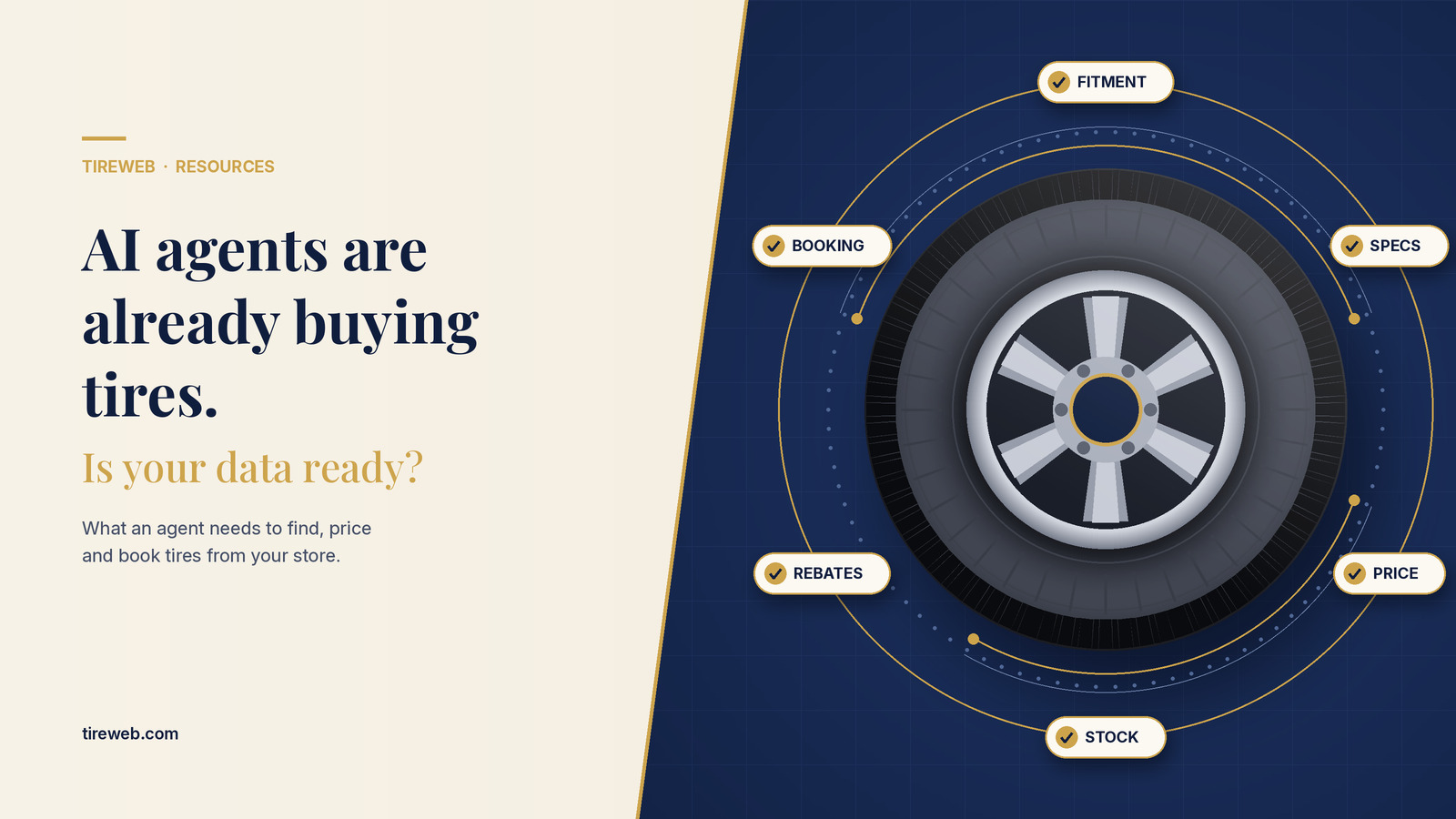
An agent is a very impatient customer. A person will put up with friction. They'll click around, squint at a blurry spec sheet or pick up the phone. An agent has far less patience for it. It reads your pages, compares what it finds with other dealers and tends to act on whichever answer is clearest. Some agents will even call, but every question your site can't answer is still a reason for it to move on to a dealer that can. For tires, it needs five things.
1. Structured fitment
An agent needs year, make, model and trim mapped to the correct tire sizes, including staggered fitments, load index and speed rating. If fitment is vague, the agent may give up. If it's wrong, it recommends the wrong tire, which is worse.
2. Accurate, live price and stock
Agents take what your site says at face value. If a tire shows as in stock at a price, the agent is likely to act on it. If that's stale, you lose the sale and probably the customer.
3. Clear installation and booking options
Most buyers need tires installed. An agent needs to know where, what it costs, what's included (mounting, balancing, valve stems, disposal) and when the next slot is. If the only way to book is "call us", the agent may not be able to complete the purchase.
4. Machine-readable product data and schema
Product names, specs, UTQG ratings, warranties and rebates need to exist as structured data, not just styled text. Schema.org markup for products, offers and local business details is the baseline.
5. Policies an agent can read
Returns, warranties, road hazard coverage, payment options. If these are buried in a PDF or written vaguely, an agent may not be able to tell its user what they're signing up for.
Where dealer data breaks
I spend a lot of time looking at other tire websites, not just the ones we build. When the visitor is an agent rather than a person, these are the failures I see again and again.
- Site structure agents can't use. Key information sits in scripts, pop-ups and image carousels instead of clean, crawlable pages. A person can click around. An agent needs a page per product with the facts in the HTML.
- Bad product definitions. Internal SKUs instead of manufacturer part numbers. The same tire listed several different ways. Load index, speed rating or UTQG missing on one page and different on the next. If an agent can't tell which tire it's looking at, it's unlikely to compare it or recommend it.
- Wrong fitment data. Outdated vehicle data, missing trims and ignored staggered setups. Wrong fitment puts the wrong tire on a real customer's order with your name on it.
- No way to actually buy or schedule. A good catalog that ends in a phone number or a contact form. An inquiry is useful, but it is a different outcome from a completed order or confirmed appointment.
- No pricing. An agent may not be able to call, and it's unlikely to put a tire it can't price in front of its user. "Call for price" used to cost you some shoppers. With agents, it can cost you far more.
- Poor visibility in AI assistants. If an assistant doesn't know your store exists, it's unlikely to consider you. There's no second page of results to scroll to.
- Blocking AI entirely. robots.txt rules that disallow AI crawlers, or Cloudflare, DNS and bot-protection settings that challenge or block automated visitors. Sometimes that's deliberate. Often it's a default nobody has revisited. Either way, the agent sees a wall instead of your inventory.
- Outdated prices or stock. Prices or availability that don't match what the dealer can actually supply.
- Late installation charges. Mounting, balancing and disposal fees that only appear late in checkout.
- Unclear delivery or collection timing. No clear answer on when the customer can get the tires or have them fitted.
Most of this isn't new. What's changed is the cost. When a person hits a problem, they might call you. When an agent hits one, it may move on to the next dealer whose data answers the question cleanly.
A practical readiness checklist
Here's what I'd work through, roughly in this order.
For dealers
- Check robots.txt and your CDN and bot-protection settings so you aren't blocking the AI crawlers and agents you actually want.
- Test your own fitment. Pick a handful of vehicles your customers actually drive and check every result, including trims and staggered setups.
- List consistent manufacturer part numbers and full specs for every tire, including size, load index, speed rating and UTQG, not internal SKUs.
- Show real prices. Replace "Call for price" with a price, ideally an installed price.
- Connect price and stock to the source, so your website reflects your POS or supplier feed automatically.
- Put rebates on the product page as text, with start and end dates.
- Make installation explicit and offer online booking with real availability.
- Build AI visibility: structured data (Product, Offer, LocalBusiness) that validates, consistent business listings everywhere you appear, and crawlable pages.
- Publish your policies as plain-language web pages, not PDFs.
- Try it yourself. Ask an AI assistant to find and book tires for your own vehicle at your own store, and note where it gets stuck.
For a fuller test, choose a vehicle and a realistic customer request, use an agent that can interact with websites, set clear limits on what it is authorized to do, and see whether it can:
- Find the correct tires
- Confirm quantity and availability
- Establish the total installed price
- Select a suitable location and appointment
- Complete the authorized purchase steps
- Obtain an accurate order confirmation
Record where it gets stuck, then work with your website and system providers to fix those points.
For distributors and wholesalers
- Publish catalog, pricing and availability through an API or feed your dealers can consume directly.
- Keep specs, part numbers, fitment and MAP in one source of truth.
- Make B2B ordering possible without a phone call or an email chain.
- Support integrations with the POS and ERP systems your dealers actually run.
- Test the same process against account-specific pricing, warehouse availability, delivery rules and ordering permissions, so an agent acting for a dealer follows the same commercial rules as that dealer.
If that looks like a lot, start with access, fitment and pricing. If an agent can't reach your site, can't match the tire or can't see a price, not much else matters.
What we're doing about it at Tireweb
Our strategy is simple to say: we're building tire industry data infrastructure that works for people and for AI agents. The same accurate data should power a dealer's website, a distributor's ordering portal and an agent querying on someone's behalf.
That starts with Tirelibrary, our tire data catalog covering 440+ brands, with fitment, specs, rebates and MAP. It's available by subscription, API and CSV, and through an MCP server, so AI assistants can query tire data directly instead of scraping pages and guessing. For the technical detail, see how the Tirelibrary API and MCP server work.
Around that data sit our products:
- Tireweb Retail gives dealers websites built on structured fitment, live data and online booking.
- Tireweb Wholesale handles B2B ordering, so distributors can sell to dealers without the phone tag.
- Tireweb Connections links point-of-sale and ERP systems, so pricing and stock stay in sync.
- Tireweb AI, which we launched in 2026, is our work on making that data and those workflows usable by AI agents.
I don't think AI agents will replace the relationship between a dealer and their customers. I do think they'll increasingly decide which dealers get considered in the first place. The ones with clean, structured, current, reachable data will make the shortlist. The rest may never find out why the inquiries went quiet.
Want to know where an AI-assisted purchase might get stuck on your website? Talk to the Tireweb team about your product data, pricing, availability and online buying process.
Frequently asked questions
Are AI agents really buying tires today?
Yes. Across the dealer websites Tireweb runs, we're already seeing AI agents browsing, making inquiries and buying tires on behalf of customers. It's early, but it's happening on live sites now.
What data does an AI agent need to buy tires?
Accurate fitment by year, make, model and trim; live price and stock; clear installation and booking options; machine-readable product data with schema markup; and plain-language policies for returns, warranties and payment.
What is an MCP server, and why does it matter for tire data?
MCP (Model Context Protocol) is an open standard that lets AI assistants connect to external data sources and tools. Tirelibrary's MCP server lets AI assistants query structured tire data, including fitment, specs, rebates and MAP, directly rather than scraping web pages.
Where should a tire dealer start?
Start with fitment accuracy and live pricing, since those cause the most damage when wrong. Then add online booking, structured product data and clear policy pages, and test the result by asking an AI assistant to buy tires from your own site.
Should I block AI crawlers on my tire website?
Blocking AI crawlers in robots.txt, or leaving CDN bot protection to challenge them by default, can keep your store out of the AI assistants your customers use. Keep protection against abusive bots, but review which AI crawlers and agents you allow and make that a deliberate choice rather than a default.
Does an MCP server make a website ready for AI agents?
No. An MCP server gives compatible AI assistants direct access to structured data, which helps. It doesn't fix wrong fitment, stale stock, missing prices, checkout or scheduling. Those parts of the buying process still need to work on your own site.

Matthew Walker
Chief Executive Officer, Tireweb
Matthew Walker is the CEO of Tireweb, where he works with tire businesses around the world to help them operate more efficiently and serve customers better through technology. Having spent much of his career at the intersection of tires, automotive retail, and software, Matthew enjoys exploring new ideas, industry trends, and practical ways businesses can embrace change. His articles focus on the real-world challenges facing the tire industry and the opportunities technology creates for future growth.